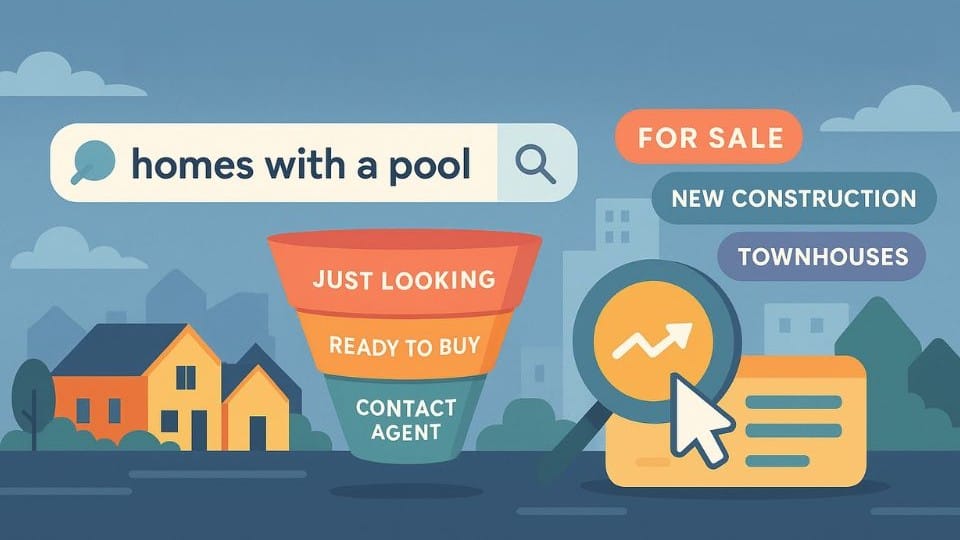
Most blog posts about real estate keywords make the same mistake.
They throw a giant list of search terms at you, maybe mention search volume, and leave it there. That might look useful on the surface, but it skips the part that actually matters: why someone searched that phrase in the first place.
Not all real estate keywords mean the same thing. A person searching “how much house can I afford” is in a very different place than someone searching “3-bedroom homes for sale in Alpharetta with fenced yard.” One is still figuring things out. The other is much closer to making a move.
That difference is everything.
I’ve worked in real estate SEO long enough to see how often agents chase traffic that looks good in a report but doesn’t lead to much. More impressions can feel exciting, but if the traffic is too broad or the intent is weak, it usually doesn’t turn into real business. The better play is to understand buyer intent and build content around what people actually need at each stage.
That’s how you attract more qualified traffic. More importantly, that’s how you attract better leads.
What are real estate keywords by buyer intent?
Buyer intent is the reason behind the search.
It tells you where someone is in the buying process and what kind of page is most likely to help them next. In real estate, that matters because buyers don’t search the same way at every stage.
Early on, they’re asking broad questions. Later, they start comparing neighborhoods, schools, budgets, and commute times. When they get closer to action, their searches become much more specific.
In real estate, I usually think about keyword intent in three practical stages:
- Early interest: they’re exploring and learning
- Research and comparison: they’re narrowing options
- High intent: they’re close to touring, contacting, or buying
If you can match your content to those stages, your SEO gets a lot stronger.
Remember – “high volume” does not always mean “high value.”
Stage 1: Early interest keywords
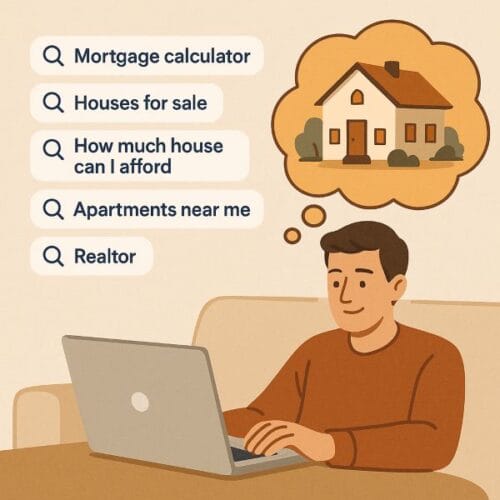
These are the broad, early searches.
People here are still learning. They may be thinking about buying in the next few months, or just trying to figure out whether buying is realistic at all.
Common early-interest keyword examples
- How much house can I afford
- Mortgage calculator
- How to buy a house
- Homes for sale near me
- First-time homebuyer tips
- What is mortgage pre-approval
- Best time to buy a house
- Real estate market trends
These searches usually signal curiosity more than urgency. That doesn’t mean they’re low value. It just means the content needs to meet people where they are.
What this tells you about the buyer
Buyers at this stage are trying to build confidence. They want answers, not pressure. They’re looking for clarity around money, timing, and the overall homebuying process.
This is where agents have a chance to get on someone’s radar early.
What agents should create for this stage
Early-stage keywords work best with educational content.
That might include:
- first-time buyer guides
- affordability explainers
- mortgage and pre-approval articles
- local market primers
- blog posts that answer basic questions in plain English
Strong examples:
- How to Buy a House in Georgia
- What First-Time Buyers Should Know Before Getting Pre-Approved
- How Much House Can You Afford in Atlanta?
- Renting vs. Buying in East Cobb
This kind of content may not drive the fastest conversion, but it builds trust early.
In real estate, that matters a lot.
Stage 2: Research-and-comparison keywords
This is where buyer intent starts getting more serious.
These searchers have moved past the broad questions. Now they’re comparing options. They’re trying to figure out where they want to live, what they can afford, what kind of neighborhood fits their lifestyle, and whether a certain area makes sense for their family, commute, or budget.
Common research-and-comparison keyword examples
“best places to live in [city]”
“first-time homebuyer programs [state]”
“school ratings in [county]”
“cost of living in [city]”
“average home prices in [city]”
“safest neighborhoods in [city]”
“walkable neighborhoods in [city]”
“[neighborhood] vs [neighborhood]”
“best suburbs of [city] for families”
“crime rate in [neighborhood]”
“[city] real estate market forecast”
“best areas in [city] for young professionals”
“homes near top-rated schools [location]”
“property tax rates in [county]”
“public transportation in [city]”
“best neighborhoods for first-time buyers [city]”
“real estate trends in [city]”
“most affordable neighborhoods in [city]”
“how competitive is the housing market in [city]”
“[city] vs [city] cost of living”
“up-and-coming neighborhoods in [city]”
“best places to retire in [state]”
“best school districts in [state]”
“homes near downtown [city]”
“pros and cons of living in [city]”
“family-friendly neighborhoods in [city]”
“average closing costs in [state]”
“how much do homes cost in [city]”
“living in [neighborhood] reviews”
“is [city] a good place to live”
“best areas in [city] for investors”
“homes with land in [region]”
“best zip codes to buy a house in [city]”
“[neighborhood] housing market”
“walk score of [neighborhood]”
“new developments in [city]”
“homes near BeltLine / greenway / transit”
“school zoning map for [district or county]”
“pet-friendly neighborhoods in [city]”
“[city] neighborhood guide”
“average rent vs mortgage in [city]”
“best neighborhoods in [city] with parks”
“buying a home in [school district name]”
“where to live in [city] for short commute”
“real estate market update [month/year] [city]”
“best real estate investments in [city]”
“community amenities in [neighborhood]”
“homes near top employers in [city]”
“luxury neighborhoods in [city]”
“homebuyer grants or assistance in [city/state]”
These searches are often some of the best opportunities in real estate SEO because they combine local intent with real decision-making.
What these keywords tell you about the buyer
These people are closer than they look.
They may not be filling out a contact form today, but they are actively narrowing the field. In my experience, this is one of the best content stages for real estate SEO because it lets you combine local expertise with real search intent.
This is where strong local content can really separate you from bigger national sites. A national portal can show listings. It usually can’t explain a neighborhood the way a local expert can.
What agents should create for this stage
This is where hyper-local content shines.
Good formats include:
Build comparison content: Posts like “Roswell vs. Alpharetta: Which Is Better for Families?” or “The 5 Best Suburbs of Atlanta for Remote Workers” rank well and help buyers make decisions.
Create school and lifestyle-based neighborhood guides: Include walkability, parks, schools, and commute insights, not just listings.
Write market trend content: Short, local updates on home prices or time-on-market in your area help you show up for long-tail “market forecast” queries.
Use local keywords across landing pages: For each neighborhood you serve, make sure the page title, H1, and meta description reflect what people are searching. Terms like “homes near top schools in Brookhaven” or “best neighborhoods in East Cobb under 700k.”
These are good SEO topics because they align with how buyers actually think once they’ve moved past the earliest stage.
Stage 3: High-intent real estate keywords
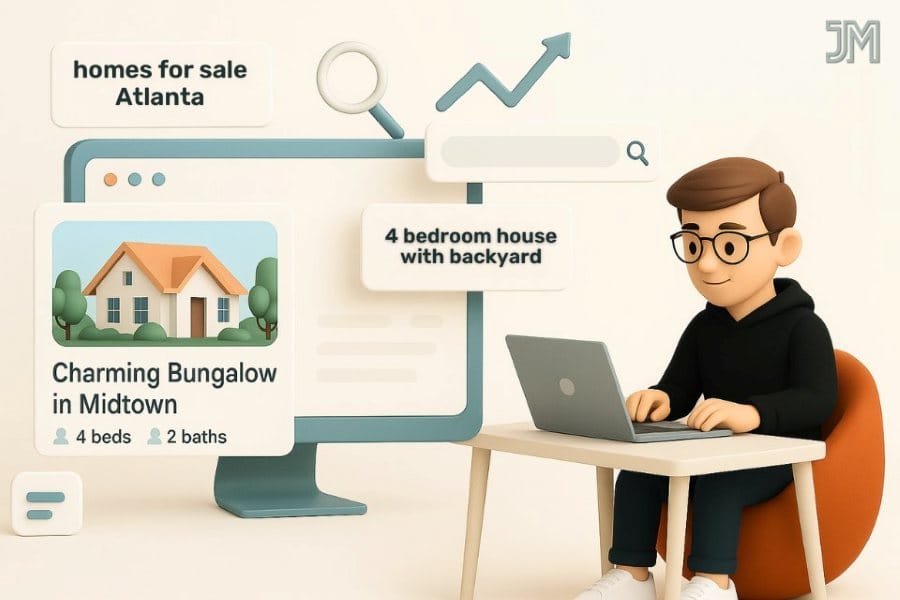
This is where searches get much more specific.
By this point, the buyer usually knows what they want, where they want it, or who they need help from. These are the searches most closely tied to action.
Common high-intent real estate keywords:
“3 bedroom homes for sale in [neighborhood]”
“homes for sale near [school name or landmark]”
“townhomes for sale in [city] under $400k”
“new construction homes in [city]”
“homes with basement in [neighborhood]”
“condos for sale near [university/downtown]”
“homes with pool in [city]”
“homes for sale in [zip code]”
“luxury homes in [neighborhood]”
“real estate agent in [neighborhood]”
“realtors near me”
“schedule home tour in [city]”
“homes with fenced yard in [neighborhood]”
“[neighborhood] open houses this weekend”
“[city] real estate listings”
“move-in ready homes in [city]”
“homes near [company HQ/employer]”
“top rated real estate agents in [city]”
“best buyer’s agents in [neighborhood]”
“houses for sale by owner in [city]”
“townhomes with garage in [area]”
“homes in [subdivision or development name]”
“4 bedroom homes under $500k in [suburb]”
“modern homes for sale in [city]”
“gated communities in [county or suburb]”
“homes on cul-de-sac in [neighborhood]”
“energy-efficient homes in [city]”
“homes near parks and trails in [city]”
“homes for sale near public transit [city]”
“price reduced homes in [area]”
“best home deals in [city] this week”
“homes with in-law suite in [neighborhood]”
“new townhome communities in [metro area]”
“[builder name] homes for sale in [city]”
“homes near lake or waterfront in [state]”
“historic homes for sale in [city]”
“ranch-style homes in [neighborhood]”
“homes with office or flex space in [city]”
“[city] homes near good daycare centers”
“investment properties in [zip code]”
“pet-friendly homes in [city]”
“starter homes in [city]”
“[price range] homes in [neighborhood]”
“real estate agent reviews [city]”
“best buyer incentives in [new development]”
“homes for quick closing in [market]”
“fixer-uppers in [neighborhood]”
“homes near top-rated high schools [area]”
“low HOA homes for sale in [city]”
“homes for sale with virtual tour in [city]”
These searches tend to be more detailed because the buyer is further along. They’re not looking for broad advice anymore. They’re trying to find the right property, the right area, or the right agent.
What these keywords tell you
This is the closest thing to a hand raise.
When someone searches for a very specific property type, feature, neighborhood, or service, they are usually much closer to taking the next step. That’s why these keywords often matter more than broad terms with bigger search volume.
How agents can rank for these keywords
These keywords usually work best with targeted pages.
That might include:
Create landing pages for specific property types
(e.g. “Homes with Pools in Milton Under 700k”) – Targeted pages rank faster and convert better.Write listing-level SEO descriptions
Instead of “Beautiful home in great neighborhood,” write “3 bed, 2.5 bath home in East Cobb with finished basement and fenced yard.”Update your Google Business Profile
Make sure your profile matches these high-intent searches. Include service areas, specialties, and keywords in your description.Add conversion points everywhere
CTAs like “Schedule a tour,” “Ask a question,” or “See similar homes” should appear on every page targeting these keywords.
These pages should also make it easy for someone to act. If the page matches strong buyer intent, there should be a clear next step on it.
Why search volume isn’t enough
This is one of the biggest mistakes I see in keyword strategy.
A lot of people assume the best keyword is the one with the biggest monthly search volume. Usually, it isn’t.
A broad term like “real estate” may get a lot of searches, but it’s vague. The intent is all over the place. Compare that to something like “homes with fenced yard in Johns Creek” or “buyer’s agent in Buckhead.” Those keywords may have lower volume, but the intent is much stronger and the traffic is much more likely to convert.
That’s why I’d rather target a cluster of specific, high-fit searches than chase one giant keyword that doesn’t line up well with the page or the person behind it.
The right keyword is the one that matches:
- the buyer’s stage
- the page you’re building
- the area you serve
- the action you want them to take
How to build a real estate keyword strategy around buyer intent
The simplest way to think about this is by matching the keyword to the right type of page.
For early-interest keywords
Create educational content.
Think:
- blog posts
- first-time buyer guides
- financing explainers
- local market primers
For research-and-comparison keywords
Create local decision-making content.
Think:
- neighborhood guides
- city vs city comparisons
- school and commute content
- price range and lifestyle pages
For high-intent keywords
Create action-oriented pages.
Think:
- service pages
- targeted location pages
- property-type pages
- listing pages
- pages with clear calls to action
This is where keyword strategy becomes useful. It stops being a spreadsheet exercise and starts becoming a content plan.
What real estate agents should stop doing
There are a few things I would stop doing right away if the goal is better SEO and better leads.
- Stop chasing broad traffic just to chase traffic
A page that gets a lot of impressions but brings the wrong audience is not doing you much good. - Stop publishing generic content that could work in any city
Real estate SEO works best when the content feels tied to a real market, real neighborhoods, and real buyer questions. - Stop building pages with weak intent match
If the keyword suggests someone wants comparison content, don’t send them to a generic homepage. If the keyword is high intent, don’t bury the CTA. - Stop treating all keywords the same
They are not the same, and they shouldn’t be handled the same way.
What tends to work best in real estate SEO
The real estate websites that tend to perform better usually are not trying to rank for everything.
They’re usually doing a better job of matching intent.
That’s really what this comes down to.
A keyword can get a lot of impressions and still be weak for business. Another keyword can have modest volume and quietly become one of the best drivers of qualified leads on your site.
Buyer intent helps you tell the difference.
If you build content around what buyers are actually trying to do, your SEO gets a lot sharper. Your pages become easier to plan. Your content becomes more useful. And your traffic gets a lot closer to the kind that can turn into real business.
That’s what makes keyword strategy worth the effort in the first place.
Let’s grow your traffic together
Have an SEO question or need help with a project? Whether you’re a small business or a national brand, I’ll help you rank higher and convert more.