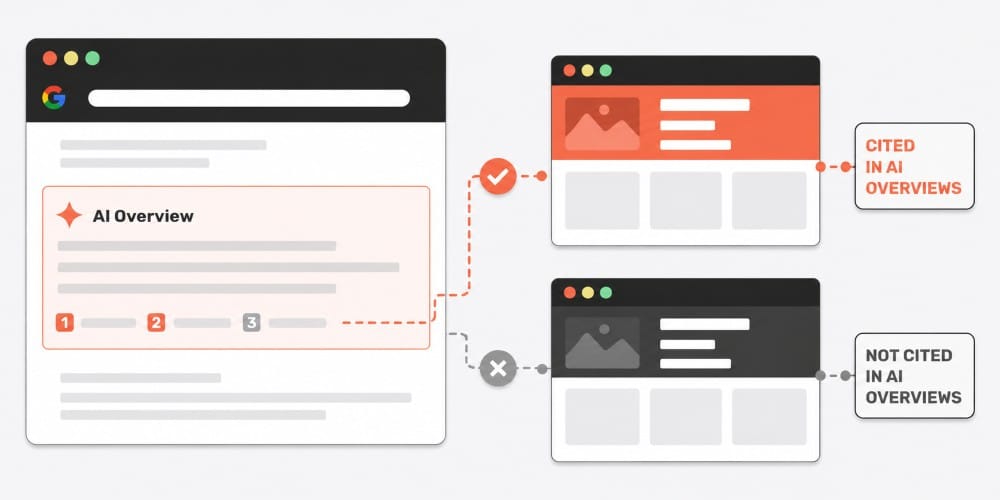
If you’ve been paying attention to Google search lately, you’ve probably noticed something strange.
They’re not always the top-ranking results. They’re not always from the biggest sites. And sometimes they’re pulled from pages you wouldn’t expect to beat more established content.
That’s what’s confusing people.
There’s a gap right now between what ranks in traditional search and what gets cited in AI-generated answers. Most SEO advice hasn’t caught up to that yet.
From what I’ve been seeing, getting cited has less to do with “ranking better” and more to do with how easy your content is to understand and pull from.
A few patterns keep showing up.
Do you need to rank #1 to get cited in AI Overviews?
No. You don’t need to rank at the top to get cited.
AI Overviews regularly pull from pages outside the top positions. In some cases, the cited source isn’t even the strongest result on the page from a traditional SEO standpoint.
Ranking helps with visibility, but it isn’t what determines whether your content gets cited.
What matters more is how clearly your content answers the question.
If a section is:
- direct
- easy to read
- and complete on its own
…it has a better chance of being pulled into an AI response.
On the flip side, a high-ranking page can get skipped if the answer is buried, hard to scan, or takes too long to get to the point.
A simple way to think about it: Ranking gets you visibility, clarity gets your content used. And right now, clarity is doing more of the heavy lifting than most people expect.
Do direct answers increase your chances of being cited?
Yes. Pages that answer questions immediately are far more likely to get cited.
AI Overviews aren’t pulling entire articles. They’re pulling small sections that clearly match the query.
Content gets cited when the answer is easy to extract without additional context.
That’s where most content falls short.
A lot of blog posts still follow a slow build. Intro, background, context, then eventually the answer. That can still rank, but it doesn’t work as well for AI retrieval.
What works better
If someone searches:
“Does AI-generated content hurt SEO?”
A strong answer looks like:
AI-generated content does not hurt SEO if it’s accurate, helpful, and written for users.
That’s clear. It answers the question immediately.
A longer explanation might still rank, but it’s harder to pull from.
How to adjust your content
You don’t need to rewrite everything you’ve ever published. But going forward, it’s worth being more intentional about how you structure key sections.
- Answer the question in the first sentence
- Keep the initial answer tight
- Expand after, not before
Clear answers outperform detailed ones when it comes to AI citations.
Does content structure impact AI Overview citations?
Yes. Structure plays a major role in whether your content gets pulled.
AI systems scan for sections they can understand quickly. If your content is hard to break apart, it’s less likely to be used.
Well-structured content is easier for AI systems to extract and reuse.
What strong structure looks like
You don’t need anything fancy. In most cases, simple wins.
- Clear H2 and H3 headings
- Short paragraphs focused on one idea
- Sections that make sense on their own
Each section should work as a standalone answer.
What hurts you
- Long, blended paragraphs
- Vague or clever headings
- Multiple ideas packed into one section
Even strong content gets skipped if it’s hard to parse.
In short, structure helps more than just your rankings. It helps your content get selected.
Does domain authority still matter for AI Overviews?
Yes, but not in the way most people think.
You don’t need the highest authority site to get cited. But you do need to look trustworthy within a topic.
From what I’ve seen, AI systems seem to favor topical consistency over raw domain authority.
That’s why smaller sites still show up.
What matters more now
- Consistently covering a topic
- Publishing related content
- Reinforcing the same subject across pages
This builds topical trust.
Where people get it wrong
Publishing one strong post isn’t enough.
If your site touches a topic once, it’s harder to trust. If you cover it repeatedly, it becomes easier to validate.
Authority now comes from consistency, not just backlinks.
Does internal linking help with AI SEO?
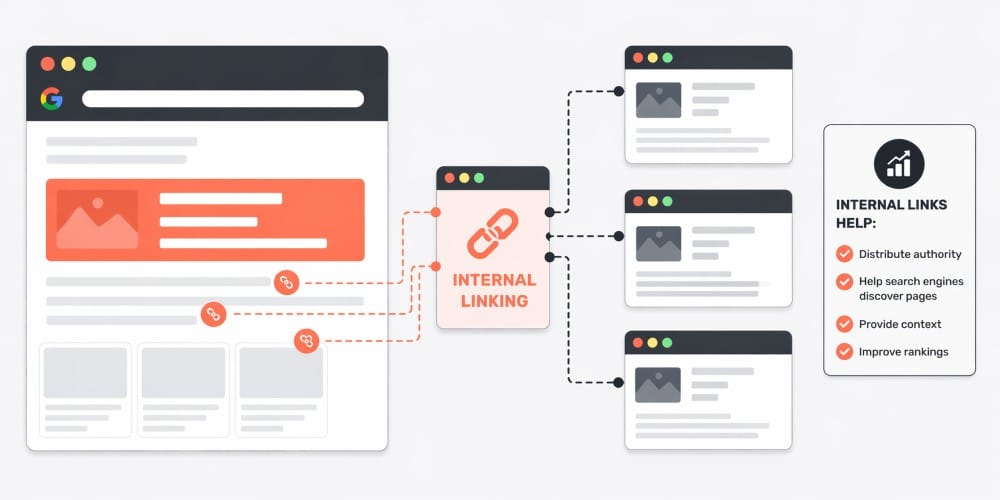
Yes. Internal linking helps define how your content connects.
It’s one of the more overlooked signals right now.
Internal links help Google understand relationships between topics on your site.
That context matters for AI systems.
Example (real estate SEO)
Instead of one post, you build a group:
- “Homes for sale in Atlanta”
- “Best neighborhoods in Atlanta”
- “Atlanta real estate market trends”
- “Is now a good time to buy in Atlanta?”
If these pages link together naturally, you reinforce the same topic.
Now Google sees a connected body of content, not isolated posts.
What to focus on
- Link to related pages where it adds context
- Use clear, natural anchor text
- Connect content within the same topic
Good internal linking turns separate posts into a trusted topic cluster.
What doesn’t seem to matter (as much)
This is the part most people don’t talk about.
There’s still a lot of SEO advice floating around that sounds right, but doesn’t fully line up with what’s actually getting pulled into AI Overviews.
That doesn’t mean these things are useless. It just means they don’t carry the same weight here as they do in traditional rankings.
Word count isn’t a deciding factor
Long-form content still has its place. It can rank well, build authority, and keep people on the page longer.
But when it comes to getting cited, length doesn’t seem to matter much on its own.
AI systems aren’t pulling entire articles. They’re pulling specific sections. A clean, well-written paragraph on a shorter page can get cited just as easily as something buried in a 3,000-word guide.
If anything, overly long content can work against you if the answer is hard to find.
Over-optimization doesn’t help
Stuffing keywords into headings, repeating the same phrase over and over, forcing exact match terms into every section, none of that seems to move the needle here.
In some cases, it makes content harder to read and less natural, which works against you.
The pages getting cited tend to read like they were written for people first.
Clear language. Natural phrasing. No obvious attempt to “optimize” every sentence.
Perfect formatting isn’t required
You don’t need a perfectly structured, perfectly optimized page for every post.
Some of the content getting pulled is surprisingly simple. It just happens to answer the question clearly and directly.
That’s the common thread.
Not perfect SEO. Not perfect design. Just useful content that’s easy to extract.
There’s a clear shift in how content gets surfaced.
Ranking still matters, but it’s not the only factor anymore. The pages getting cited are the ones that are easy to understand, easy to extract from, and directly answer the question.
If you keep things simple, clear, and focused on real questions, you’re already ahead of most of what’s out there.
That’s where things are headed.
Let’s grow your traffic together
Have an SEO question or need help with a project? Whether you’re a small business or a national brand, I’ll help you rank higher and convert more.